

Our projects
Royal School of Needlework
Combining art and advocacy, Hope for Home in partnership with The Royal School of Needlework (RSN) are championing biodiversity, using needle and thread to craft powerful messages about the importance of protecting the natural world.
‘Fragile Threads’, is an innovative and collaborative partnership programme made possible thanks to a £247,000 grant to The Royal School of Needlework from The National Lottery Heritage Fund and aims to spotlight endangered species, celebrate ecosystems, raising awareness and inspiring action to preserve the planet's extraordinary biological diversity.
Hope for Home will work with around 60 socially isolated unpaid carers of people with advanced dementia who are being cared for at home to create simple nature-inspired embroidery pieces. We will work with the designer appointed by the RSN with a small panel of carers and people with dementia being cared for at home across the UK to help advise, and later to test the new sewing kits before they are sent out across the country.
These pieces will contribute to an exciting display for our final exhibition. Expert support will be provided virtually and by telephone. It is hoped that this creative needlework will contribute to the wellbeing of these carers and allow them some time for relaxation away from their caring responsibilities.
Hope for Home is very excited about this new partnership, and about this very innovative and interesting creative project. We hope that many unpaid carers will wish to engage and take part in the stitching, which will take place during 2026. We anticipate that anyone actively engaged in caring and supporting someone with dementia living at home will wish to join in. For example, friends, family, including grandchildren, children, spouses, nieces and nephews.
This project is offered entirely free to all those who wish to take part.
Embroidery is an art form celebrated for its intricate beauty and throughout history has served as a dynamic medium for environmental storytelling. Unique and rich embroidery traditions have used stitching to record events, impart knowledge, and make powerful statements. Fragile Threads places creative self-expression and the fragility of the natural world side by side. Embroiderers have always looked to the natural world for inspiration, and their artwork has recorded the movement of species around the world, mapping their importance to global social and economic networks. However, 37% of species in the UK have experienced population decline over the past 50 years, and globally one million species are thought to be at risk.
Partnerships in this project also include several other organisations – Action for Conservation, Global Generation, Intoart and QEST.
As part of the initiative, the Royal School of Needlework will also host a symposium and an exhibition towards the end of the programme.
Hope for Home will work with around 60 socially isolated unpaid carers of people with advanced dementia who are being cared for at home to create simple nature-inspired embroidery pieces. We will work with the designer appointed by the RSN with a small panel of carers and people with dementia being cared for at home across the UK to help advise, and later to test the new sewing kits before they are sent out across the country.
These pieces will contribute to an exciting display for our final exhibition. Expert support will be provided virtually and by telephone. It is hoped that this creative needlework will contribute to the wellbeing of these carers and allow them some time for relaxation away from their caring responsibilities.
Hope for Home is very excited about this new partnership, and about this very innovative and interesting creative project. We hope that many unpaid carers will wish to engage and take part in the stitching, which will take place during 2026. We anticipate that anyone actively engaged in caring and supporting someone with dementia living at home will wish to join in. For example, friends, family, including grandchildren, children, spouses, nieces and nephews.
This project is offered entirely free to all those who wish to take part.
Embroidery is an art form celebrated for its intricate beauty and throughout history has served as a dynamic medium for environmental storytelling. Unique and rich embroidery traditions have used stitching to record events, impart knowledge, and make powerful statements. Fragile Threads places creative self-expression and the fragility of the natural world side by side. Embroiderers have always looked to the natural world for inspiration, and their artwork has recorded the movement of species around the world, mapping their importance to global social and economic networks. However, 37% of species in the UK have experienced population decline over the past 50 years, and globally one million species are thought to be at risk.
Partnerships in this project also include several other organisations – Action for Conservation, Global Generation, Intoart and QEST.
As part of the initiative, the Royal School of Needlework will also host a symposium and an exhibition towards the end of the programme.
Apply Now
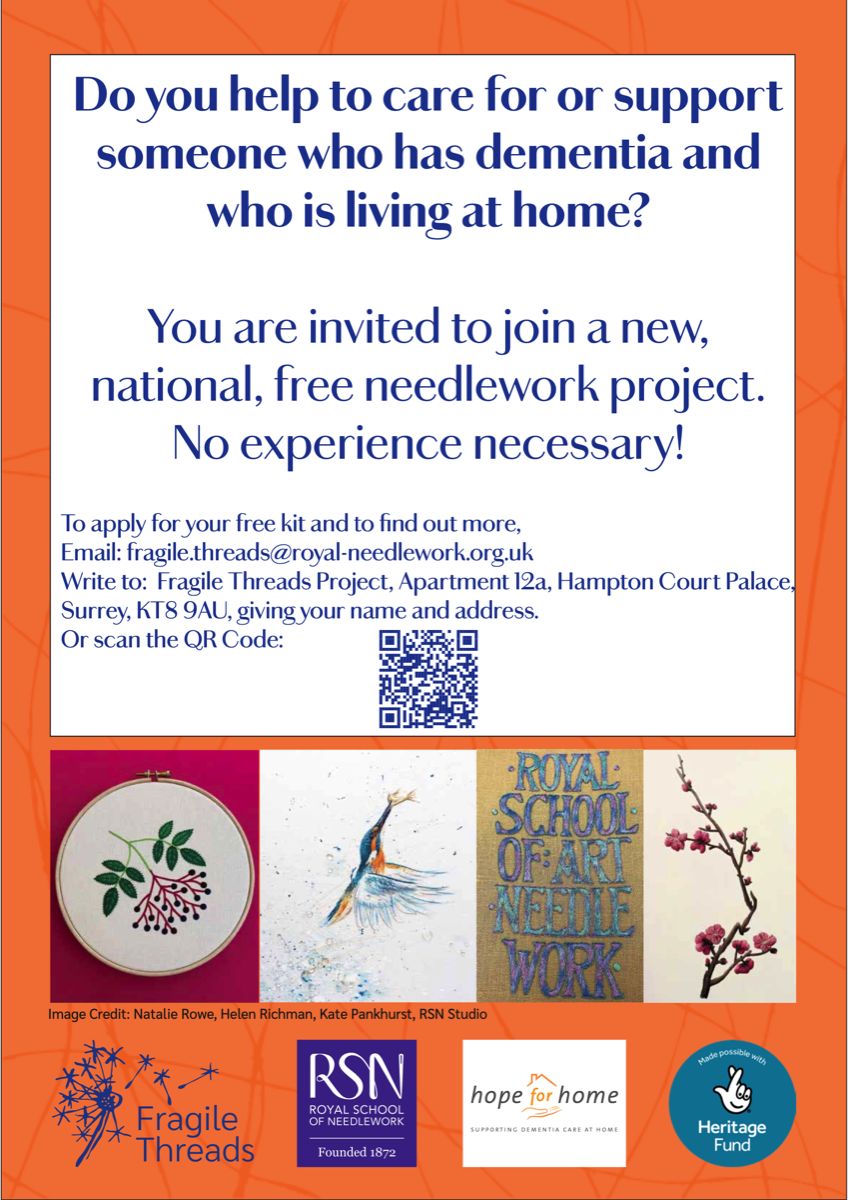
The Royal School of Needlework (RSN) in partnership with Hope for Home is looking for carers to participate in a free embroidery project: Fragile Threads.
No experience of embroidery is required.
We are looking for up to 100 carers to each make a small embroidery piece that will be combined into a larger artwork to be displayed in the RSN’s 2027 Fragile Threads exhibition to be held in London.
The aim of Fragile Threads is to connect people through shared stories, stitching meaning into everyday life, whilst highlighting the importance and vulnerability of the natural world.
If you’d like to learn more about the project, please visit our website here: www.royal-needlework.org.uk/fragile-threads/hopeforhome
To receive an information pack by post, return this flyer, entering your contact details below to: Fragile Threads Project, Apartment 12a, Hampton Court Palace, Surrey, KT8 9AU.
No experience of embroidery is required.
We are looking for up to 100 carers to each make a small embroidery piece that will be combined into a larger artwork to be displayed in the RSN’s 2027 Fragile Threads exhibition to be held in London.
The aim of Fragile Threads is to connect people through shared stories, stitching meaning into everyday life, whilst highlighting the importance and vulnerability of the natural world.
If you’d like to learn more about the project, please visit our website here: www.royal-needlework.org.uk/fragile-threads/hopeforhome
To receive an information pack by post, return this flyer, entering your contact details below to: Fragile Threads Project, Apartment 12a, Hampton Court Palace, Surrey, KT8 9AU.
Thelma Harvey Memorial Prize
We set up the Thelma Harvey Memorial Prize in 2019 to reward innovation in care and give recognition to those who make a positive difference for people with dementia. Our first prize was was awarded at the annual Hospice UK Conference in 2019.


Sadly, after 10 years as Chair, Thelma died in 2018. To recognise Thelma’s fantastic contribution and commitment we set up the Thelma Harvey Memorial Prize in 2019. This award was facilitated by a generous donation to the charity by a close friend of Thelma’s.
The aim of the Prize is to recognise individuals or teams who have made a positive difference by supporting unpaid carers who look after people with dementia in the last phase of life in their family home.
The Prize was first awarded in November 2019. We were delighted to receive three excellent submissions. The judging panel included representatives of Hope for Home and Hospice UK. The panel commended all the submissions on their compassionate support and work with people with dementia and their families.
After careful consideration the Care Improvement and End of Life Care service Carer’s Course, was chosen as the prize winner. The project was led by Emily Pardoe-Billings at St Giles Hospice in Whittington (West Midlands).
You can watch a film of the awards ceremony here:
https://www.hospiceuk.org/what-we-offer/courses-conferences-and-learning-events/conferences/hospice-uk-national-conf/hospice-uk-awards
After careful consideration the Care Improvement and End of Life Care service Carer’s Course, was chosen as the prize winner. The project was led by Emily Pardoe-Billings at St Giles Hospice in Whittington (West Midlands).
You can watch a film of the awards ceremony here:
https://www.hospiceuk.org/what-we-offer/courses-conferences-and-learning-events/conferences/hospice-uk-national-conf/hospice-uk-awards
More details about 2019 Winner
The Carers Course is a four week informal course to support unpaid carers with knowledge about dementia and how to prepare for the future. The programme is run by dementia social workers and other palliative care professionals. The judging panel were particularly pleased that carers were involved in the design of the programme. The team undertook careful evaluation of carers’ learning and feelings about the content, and the carers’ experience of the course informed its ongoing development of materials and curriculum.
At the time of the award, 13 courses involving 71 carers had been run with very positive feedback from all who had attended. Another benefit of the course was that it could be transferable, and other hospices which heard about it at the Hospice UK conference were interested in piloting the course.
The Carers Course is a four week informal course to support unpaid carers with knowledge about dementia and how to prepare for the future. The programme is run by dementia social workers and other palliative care professionals. The judging panel were particularly pleased that carers were involved in the design of the programme. The team undertook careful evaluation of carers’ learning and feelings about the content, and the carers’ experience of the course informed its ongoing development of materials and curriculum.
At the time of the award, 13 courses involving 71 carers had been run with very positive feedback from all who had attended. Another benefit of the course was that it could be transferable, and other hospices which heard about it at the Hospice UK conference were interested in piloting the course.
Christ Church Gipsy Hill
In December 2017, we founded a Dementia Hub at Christ Church, Gipsy Hill.

This collaborative venture is a two-year project offering regular support by way of a weekly group for people with dementia and their carers.
In addition, people living at home with dementia are offered companionship and practical support from a trained ‘compassionate neighbour’ – a trained volunteer from a new national project run by St Christopher’s Hospice, Sydenham.
Volunteers are jointly trained by Nicky Rothwell, our professional Coordinator, and by Stephanie Turner, Community Participation Lead from St Christopher’s Hospice.
In addition, people living at home with dementia are offered companionship and practical support from a trained ‘compassionate neighbour’ – a trained volunteer from a new national project run by St Christopher’s Hospice, Sydenham.
Volunteers are jointly trained by Nicky Rothwell, our professional Coordinator, and by Stephanie Turner, Community Participation Lead from St Christopher’s Hospice.
St Cuthbert's Durham
In February 2017, Hope for Home formed a new partnership with a St Cuthbert’s Hospice, Durham.

Namaste is a Hindu word meaning 'to honour the spirit within' – something that becomes increasingly difficult for the person with dementia to express as their condition progresses.
Namaste Care is one way to continue to connect with the person's likes, interests and life experiences to really honour the essence of who they are.
Our Trustees had been working with their (then) Admiral Nurse, Sharron Tolman, since Sharron attended our Namaste Masterclass in June 2016.
This masterclass, funded by Hope for Home, inspired Sharron to introduce Namaste care for people with dementia at home in her local area. Two of our Trustees worked with Sharron and her colleagues writing bids and project plans to secure funding for this project. Following successful bids to various Trust funds, funding was secured and this work, replicating our project with St Joseph’s, continues now.
In March 2018 we heard the fantastic news that our partner, St Cuthbert’s Hospice in Durham, had received a promise of new funds to continue their Namaste Care project, providing support for people with dementia and their unpaid carers at home in her local area.
Two of our Trustees have been working with members of St Cuthbert’s to get this project started.
This project replicates our project with St Joseph's Hospice.
Namaste Care is one way to continue to connect with the person's likes, interests and life experiences to really honour the essence of who they are.
Our Trustees had been working with their (then) Admiral Nurse, Sharron Tolman, since Sharron attended our Namaste Masterclass in June 2016.
This masterclass, funded by Hope for Home, inspired Sharron to introduce Namaste care for people with dementia at home in her local area. Two of our Trustees worked with Sharron and her colleagues writing bids and project plans to secure funding for this project. Following successful bids to various Trust funds, funding was secured and this work, replicating our project with St Joseph’s, continues now.
In March 2018 we heard the fantastic news that our partner, St Cuthbert’s Hospice in Durham, had received a promise of new funds to continue their Namaste Care project, providing support for people with dementia and their unpaid carers at home in her local area.
Two of our Trustees have been working with members of St Cuthbert’s to get this project started.
This project replicates our project with St Joseph's Hospice.
Hospice UK
In June 2015, we partnered with Hospice UK in publishing a substantial and comprehensive report about hospice-enabled dementia care.

Beginning with a year-long funding project in 2013, we set about to identify areas of excellence in dementia care delivered by hospices in the UK.
Our report, Hospice Enabled Dementia Care: the first steps, was a guide to help hospices establish care for people with dementia, their families and carers.
It includes an executive toolkit to help those hospice leaders who might wish to develop new services for people with dementia and their carers, listing examples of current good practice so that people interested in replicating services elsewhere may have a point of reference.
Our report, Hospice Enabled Dementia Care: the first steps, was a guide to help hospices establish care for people with dementia, their families and carers.
It includes an executive toolkit to help those hospice leaders who might wish to develop new services for people with dementia and their carers, listing examples of current good practice so that people interested in replicating services elsewhere may have a point of reference.
St Joseph's Hackney
Our first project, begun in 2014, delivered Namaste care at home for people with advanced dementia using trained volunteers in partnership with St Joseph's Hospice in Hackney.

Namaste is a Hindu word meaning ‘to honour the spirit within’ – something that becomes increasingly difficult for the person with dementia to express as their condition progresses.
Namaste Care is one way to continue to connect with the person's likes, interests and life experiences to really honour the essence of who they are.
Inspired by the work of Professor Joyce Simard (now a Patron), we used trained volunteers in the London Borough of Newham to give hand massages, to gently comb a person's, to deliver aromatherapy, to provide reminiscence and to offer special treats.
These processes contributed to ensuring quality of life.
Our work providing support for family carers of people with advanced dementia in their own family home, had never been attempted before because the notion of using trained volunteers to deliver Namaste to people with advanced dementia living at home seemed too risky a notion.
Our partnership with St Joseph's has been extremely fruitful and positive in every way.
We are proud to say that when our original funding ended St Joseph's readily took up the challenge to continue the scheme, which continues to be resoundingly successful.
This success has been very apparent to the local community, with word spreading rapidly about the positive impact of our work.
It was expanded into the neighbouring London Boroughs of Hackney and Tower Hamlets and continues now funded by the NHS.
Namaste Care is one way to continue to connect with the person's likes, interests and life experiences to really honour the essence of who they are.
Inspired by the work of Professor Joyce Simard (now a Patron), we used trained volunteers in the London Borough of Newham to give hand massages, to gently comb a person's, to deliver aromatherapy, to provide reminiscence and to offer special treats.
These processes contributed to ensuring quality of life.
Our work providing support for family carers of people with advanced dementia in their own family home, had never been attempted before because the notion of using trained volunteers to deliver Namaste to people with advanced dementia living at home seemed too risky a notion.
Our partnership with St Joseph's has been extremely fruitful and positive in every way.
We are proud to say that when our original funding ended St Joseph's readily took up the challenge to continue the scheme, which continues to be resoundingly successful.
This success has been very apparent to the local community, with word spreading rapidly about the positive impact of our work.
It was expanded into the neighbouring London Boroughs of Hackney and Tower Hamlets and continues now funded by the NHS.